[[파일:Figure 4. path through q rip.png|가운데|섬네일|Figure 4. path through <math>q_rip</math>]]
[[파일:Figure 4. path through q rip.png|가운데|섬네일|Figure 4. path through <math>q_rip</math>]]
<math>q_{rip}</math>을 거쳐서 가는 경우는 figure 4와 같이 표현된다. 따라서 이와 같은 경우에서 읽어들이는 문자열은 <math>R_1(R_2)*R_3</math>이다. 따라서 두 경로를 합친 전이 라벨은 <math>\delta'(q_i, q_j) = R_1(R_2)*R_3 \cup R_4</math>이다.
<math>q_{rip}</math>을 거쳐서 가는 경우는 figure 4와 같이 표현된다. 따라서 이와 같은 경우에서 읽어들이는 문자열은 <math>R_1(R_2)*R_3</math>이다. 따라서 두 경로를 합친 전이 라벨은 <math>\delta'(q_i, q_j) = R_1(R_2)*R_3 \cup R_4</math>이다.
정규 표현식(regular expression)은 문자열에서 특정한 패턴을 찾거나 치환·검증하기 위해 사용하는 표현식이다.
Formal Definition of Regular Expressions
정규 표현식 집합 [math]\displaystyle{ \mathcal{RE} }[/math]는 알파벳 집합 [math]\displaystyle{ \Sigma }[/math]에 대해 아래의 닫힘 조건(closure conditions)을 만족하는 최소 집합을 의미한다:
[math]\displaystyle{ a \in \mathcal{RE},\,\, \forall a \in \Sigma }[/math]
빈 문자열 [math]\displaystyle{ \epsilon }[/math]에 대해, [math]\displaystyle{ \epsilon \in \mathcal{RE} }[/math]
어떤 문자열도 포함하지 않는 공집합 [math]\displaystyle{ \empty }[/math]에 대해, [math]\displaystyle{ \empty \in \mathcal{RE} }[/math]
Union: If [math]\displaystyle{ R_1 \in \mathcal{RE}, R_2 \in \mathcal{RE} }[/math], then [math]\displaystyle{ (R_1 \cup R_2) \in \mathcal{RE} }[/math]
Concatenation: If [math]\displaystyle{ R_1 \in \mathcal{RE}, R_2 \in \mathcal{RE} }[/math], then [math]\displaystyle{ (R_1 \circ R_2) \in \mathcal{RE} }[/math]
Kleene Star: If [math]\displaystyle{ R_1 \in \mathcal{RE} }[/math], then [math]\displaystyle{ (R_1*) \in \mathcal{RE} }[/math]
이때 정규 표현식은 단순히 문자열(strings)이며, [math]\displaystyle{ \{\empty, \epsilon, (, ), \cup, \circ, *\} \cup \Sigma }[/math]라는 알파벳 집합 위에서 정의된다. 따라서, [math]\displaystyle{ a \cup b }[/math]라는 정규표현식이 문자열로 해석되어 단순히 알파벳 [math]\displaystyle{ a,\cup,b }[/math]의 조합인지, 혹은 정규표현식 [math]\displaystyle{ a, b }[/math]의 합집합으로 해석되는지는 맥락에 따라 달라진다.
Structural Induction for RE
어떤 성질 P(R)이 모든 정규 표현식 R에 대해 성립함을 보이고 싶다면 먼저, 아래와 같은 기본 케이스를 규정해야 한다:
[math]\displaystyle{ L(R_1*) = (L(R_1))* }[/math] → R1이 만드는 문자열들의 0번 이상의 반복.
이때 아래와 같은 중요한 정리(Lemma)가 존재한다.
For all regular expressions R the language L(R) is a regular language.
이를 증명하기 위해서는 구조적 귀납법(Structural Induction)을 사용하며, 이를 위해 아래의 명제들을 증명해야 한다:
Figure 1. NFA for [math]\displaystyle{ L(a) }[/math]Figure 2. NFA for [math]\displaystyle{ L(\epsilon) }[/math]Figure 3. NFA for [math]\displaystyle{ L(\empty) }[/math]
[math]\displaystyle{ \forall a \in \Sigma,\,\, L(a) }[/math] is a regular language.
[math]\displaystyle{ L(\epsilon) }[/math] is a regular language.
[math]\displaystyle{ L(\empty) }[/math] is a regular language.
[math]\displaystyle{ L(R1 \cup R2) = L(R1) \cup L(R2) }[/math] is a regular language.
[math]\displaystyle{ L(R1 \circ R2) = L(R1) \circ L(R2) }[/math] is a regular language.
[math]\displaystyle{ L(R1*) = (L(R1))* }[/math] is a regular language.
먼저, 명제 1, 2, 3들은 figure 1, 2, 3에 제시된 NFA를 통해 나타내어진다. 또한, 정규 언어들은 각 연산에 대해 닫혀(close)되어 있으므로, 명제 3, 4, 5번또한 성립한다고 할 수 있다.
Simplifying Operators
연산자 우선순위를 설정하여 괄호를 생략할 수 있는데, 그 순서는 [math]\displaystyle{ \cup \lt \circ \lt * }[/math](Kleene Star)와 같다. 또한 [math]\displaystyle{ \circ }[/math] 기호를 생략하여 보통 문자열 처럼 붙여 쓸 수 있다. 따라서, [math]\displaystyle{ 01* }[/math]과 같은 정규 표현식은 [math]\displaystyle{ 0\circ(1*) }[/math]과 같다. 또한 아래는 복잡한 정규 표현식을 단순화한 예시이다.
[math]\displaystyle{ R \equiv (0 \cup(1\cup(0(((0\cup1)*)0))\cup(1(((0\cup1)*)1)))) }[/math][math]\displaystyle{ R \equiv 0 \cup 1\cup 0(0\cup1)*0\cup1(0\cup1)*1 }[/math]
위의 예시는 사람이 읽기에 훨씬 편하도록 R을 만든 것이다. 이는 연산자 우선순위 규칙과 괄호 생략 규칙을 도입한 이유이다.
Constructing a RE from a NFA
모든 정규 언어는 정규표현식으로 표현될 수 있다. 즉, NFA가 주어지면 반드시 동치인 정규표현식이 존재한다. 이는 아래와 같은 정리(Lemma)를 통해 나타낼 수 있다:
If L is a regular language, then L = L(R) for some regular expression R.
이를 증명하는 방법은 상태 제거 절차(state elimination procedure)이며, 이는 NFA의 상태들을 하나씩 제거하면서, 그 상태를 통과하는 경로들을 정규표현식으로 바꿔가며 단순화하는 것이다. 이때 일반적인 NFA는 각각의 전이(transit)에 해당하는 화살표가 단일 문자(혹은 [math]\displaystyle{ \epsilon }[/math])으로 라벨링되어 있다. 하지만 상태를 제거하다 보면, 두 상태를 연결하는 경로가 단일 문자가 아니라 정규표현식 전체로 표현되는 경우가 생기며, 이를 더욱 쉽게 나타낼 수 있도록 GNFA(Generalized NFA)라는 개념을 도입할 수 있다. 즉, GNFA는 “전이가 단일 문자 대신 정규표현식으로 라벨링된 NFA”를 의미한다. 주어진 NFA를 GNFA로 치환하는 절차를 포함한 GNFA에 대한 자세한 설명은 GNFA 문서를 참조하면 된다.
Converting GNFA to RE
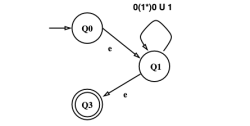
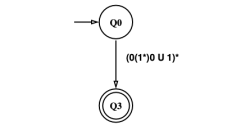
Figure 5. GNFA example
GNFA에서 RE를 얻는 절차는 기저 조건과, 재귀적 단계로 나뉜다. 먼저 기저 조건은 만약 상태가 2개(시작/종료)뿐이면, 답은 [math]\displaystyle{ \delta(q_{start}, q_{accept}) }[/math]이라는 것이다. 이는 시작 상태에서 종료 상태로 전이하는 라벨이 곧 정규표현식이라는 것을 의미한다. 재귀적 단계는 아래와 같다:
Figure 6. Remove Q2Figure 7. Remove Q1상태가 2개 초과라면, 제거할 상태 [math]\displaystyle{ q_{rip} }[/math]을 하나 선택한다. 이때 [math]\displaystyle{ q_{start}, q_{end} }[/math]는 제외한다.
[math]\displaystyle{ q_{rip} }[/math]를 제외한 새로운 상태 집합 [math]\displaystyle{ Q' = Q - \{q_{rip}\} }[/math]을 정의한다.
이에 따라 전이 [math]\displaystyle{ \delta }[/math]를 [math]\displaystyle{ \delta'(q_i, q_j) = R_1(R_2)*R_3 \cup R_4 }[/math]와 같이 재정의한다. 이때 [math]\displaystyle{ R_1,R_2,R_3,R_4 }[/math]는 아래와 같다:
[math]\displaystyle{ q_i }[/math]에서 [math]\displaystyle{ q_j }[/math]로 가는 경우는 [math]\displaystyle{ q_{rip} }[/math]를 거치는 경우와 아닌 경우 두 가지로 나뉜다. 먼저, [math]\displaystyle{ R_4 = \delta(q_i, q_j) }[/math]는 [math]\displaystyle{ q_i }[/math]에서 [math]\displaystyle{ q_j }[/math]로 [math]\displaystyle{ q_{rip} }[/math]을 거치지 않고 전이가 이뤄지는 라벨을 의미한다.
Figure 4. path through [math]\displaystyle{ q_rip }[/math]
[math]\displaystyle{ q_{rip} }[/math]을 거쳐서 가는 경우는 figure 4와 같이 표현된다. 따라서 이와 같은 경우에서 읽어들이는 문자열은 [math]\displaystyle{ R_1(R_2)*R_3 }[/math]이다. 따라서 두 경로를 합친 전이 라벨은 [math]\displaystyle{ \delta'(q_i, q_j) = R_1(R_2)*R_3 \cup R_4 }[/math]이다.